2026-03-07 14:49 Tags: Technical Literacy
SOAP vs. REST
1. First: SOAP vs REST (the simple intuition)
Think of them as two ways to design APIs.
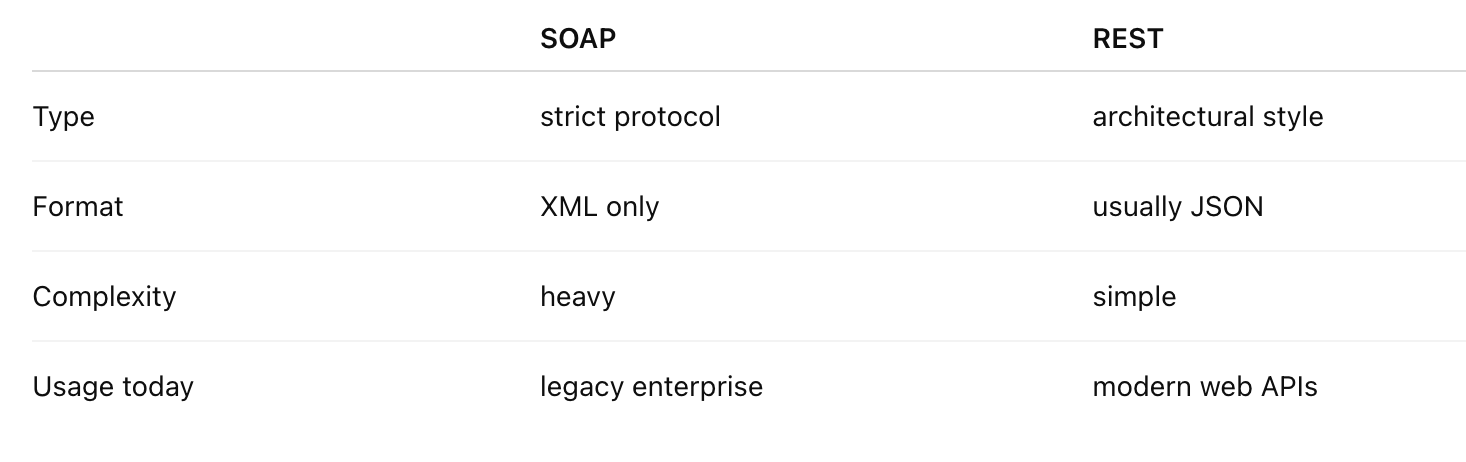
Most modern APIs (Stripe, Reddit, OpenAI, Notion) are REST APIs.
2. SOAP (the older approach)
SOAP stands for:
Simple Object Access Protocol
SOAP APIs send messages in XML format.
Example SOAP request:
<Envelope>
  <Body>
    <GetBook>
      <ISBN>9780143126560</ISBN>
    </GetBook>
  </Body>
</Envelope>
Problems with SOAP:
-
very verbose
-
complicated standards
-
heavy documentation
-
hard for developers
SOAP was popular in enterprise systems, banks, and government.
But developers hated it.
3. REST (the modern approach)
REST stands for:
Representational State Transfer
It was proposed by
Roy Fielding
in his famous PhD dissertation in 2000.
REST is not a strict protocol.
Instead, it’s a design philosophy for APIs.
Example REST request:
GET /books/9780143126560Response:
{
 "title": "The Intelligent Investor",
 "stock": 142
}
Much simpler.
4. Why REST won the internet
REST became dominant because it matches how the web works.
The web already uses:
-
URLs
-
HTTP
-
resources
REST simply builds APIs using those concepts.
Example:
GET /users
GET /users/123
POST /users
DELETE /users/123
You can literally understand the API by reading the URL.
5. The key sentence you asked about
The paragraph says REST APIs follow 6 constraints.
These come from Roy Fielding’s dissertation.
But don’t worry — they’re mostly conceptual.
RESTful API - Basics
6. The 6 REST constraints (in human language)
1️⃣ Client–Server separation
The client and server are independent.
Example:
App → API server
The client doesn’t care how the server works internally.
This allows:
-
mobile apps
-
web apps
-
other services
to use the same API.
2️⃣ Stateless communication
Each request must contain all necessary information.
The server should not remember previous requests.
Example:
Bad design:
request 1: login
request 2: get data
Good REST design:
GET /data
Authorization: Bearer token
Each request contains authentication.
Stateless systems scale better.
3️⃣ Cacheable responses
Responses should be cacheable when possible.
Example:
GET /products
The response might be cached for 5 minutes.
Benefits:
-
faster responses
-
lower server load
4️⃣ Uniform interface
This is the core REST principle.
Resources should have consistent URLs and methods.
Example:
GET /books
GET /books/123
POST /books
DELETE /books/123
Instead of weird endpoints like:
/fetchBookList
/getBookInfo
/removeBook
Uniform design makes APIs predictable.
5️⃣ Layered system
Clients don’t need to know if they’re talking to:
-
the actual server
-
a proxy
-
a cache
-
a gateway
Example architecture:
Client
 ↓
CDN
 ↓
API Gateway
 ↓
Microservices
 ↓
Database
Clients just call the API.
6️⃣ Code on demand (optional)
Servers can send executable code to clients.
Example:
JavaScript sent to browsers.
But most APIs don’t use this.
This constraint is optional.
7. Why REST became dominant
REST matched how developers already think.
Instead of:
Execute operation: getBookData
REST says:
Access resource: /books/123
It treats everything as a resource.
Example resources:
/users
/orders
/products
/payments
8. What modern APIs actually look like
In reality, most APIs are REST-ish, not perfectly REST.
Example:
-
Stripe API
-
Notion API
-
Reddit API
-
OpenAI API
They follow REST ideas but not all 6 constraints strictly.
9. For your automation work
When you call this endpoint:
https://www.reddit.com/r/startups/top.json
You are using a REST API.
The structure:
GET /r/startups/top
Resource:
subreddit posts
Response:
JSON data
10. A simple mental model
SOAP thinking:
call remote procedure
REST thinking:
access resources via URLs
11. The big idea
REST turned APIs into something like websites for machines.
Instead of humans browsing pages:
Browser → website
Machines browse APIs:
Software → API
That idea powers almost the entire modern internet.
二 Stateless communication
1. What “state” means
State = memory of previous interactions
Example conversation with a waiter:
You say:
I ordered pasta earlier.
The waiter remembers your order.
That system has state because it remembers history.
2. A stateful server (old style)
Imagine a login system like this:
Step 1:
POST /login
username=alice
password=123
Server checks credentials and stores:
User 847 logged inNow the server remembers you.
Step 2:
GET /dataServer checks its memory:
Oh yes, user 847 is logged in.
Then it returns the data.
The problem
The server must store memory for every user.
Example:
User session table
------------------
User 847
User 921
User 301
User 122
If millions of users connect:
The server must track millions of sessions.
This becomes messy and hard to scale.
3. Stateless design (REST idea)
Instead of the server remembering users…
Each request proves who you are.
Step 1: login
POST /loginServer returns a token.
Example:
token = abc123xyzStep 2: request data
Instead of the server remembering you…
You include the token:
GET /data
Authorization: Bearer abc123xyz
Now the server checks the token.
It doesn’t need to remember anything.
4. The key difference
Stateful:
Server remembers youStateless:
You prove who you are every request5. Why stateless systems scale better
Imagine you run a huge service like
Netflix.
Millions of users are sending requests.
If servers store sessions:
User session memoryRequests must go to the same server.
Otherwise the session is lost.
That creates a bottleneck.
With stateless APIs:
Any server can handle the request.
Example architecture:
Client
 ↓
Load balancer
 ↓
Server A
Server B
Server C
Server D
Every request contains:
Authorization: Bearer tokenSo any server can verify it.
This makes scaling easy.
6. Why APIs love statelessness
Stateless systems allow:
-
horizontal scaling
-
load balancing
-
caching
-
microservices
Basically everything modern infrastructure needs.
7. Real example: your Reddit API call
When you call:
https://www.reddit.com/r/startups/top.jsonReddit doesn’t remember you.
Each request is independent.
It simply returns data.
Stateless.
8. Another real example: Stripe API
When apps call the
Stripe API:
POST /charges
Authorization: Bearer sk_live_xxx
Every request includes the API key.
Stripe doesn’t need to remember previous calls.
Stateless.
9. The one-sentence intuition
Stateful system:
“I remember who you are.”
Stateless system:
“Prove who you are every request.”
10. Why this matters for builders
When you design systems with APIs, statelessness means:
Your system becomes:
-
easier to scale
-
easier to debug
-
easier to distribute
That’s why REST emphasizes it.
If you want, I can also explain something super useful for API literacy (and it will immediately help with n8n and automation):
Why APIs often return weird things like
page=1
limit=50
cursor=abc123
That concept is called pagination, and it’s one of the most important real-world API patterns.
四 Uniform interface
1. First: what is a “resource”?
In REST, everything is treated as a resource.
A resource is just a thing in the system.
Examples:
| Resource | Example URL |
|---|---|
| books | /books |
| users | /users |
| orders | /orders |
| payments | /payments |
Think of the API like a collection of objects you can interact with.
2. The REST idea: use HTTP methods consistently
Instead of inventing new verbs, REST uses the same small set of actions everywhere.
| HTTP method | Meaning |
|---|---|
| GET | read something |
| POST | create something |
| PATCH / PUT | update something |
| DELETE | remove something |
These actions stay consistent across every resource.
3. Example: a bookstore API
Resource:
books
Operations:
Get all books
GET /books
Get one book
GET /books/123
Add a new book
POST /books
Delete a book
DELETE /books/123
Notice something important:
The URL stays about the resource, not the action.
4. What bad APIs looked like before REST
Older APIs often looked like this:
/fetchBookList
/getBookInfo
/removeBook
/addBook
/updateBookPrice
Every action had its own endpoint.
Problems:
1️⃣ Hard to remember
2️⃣ Inconsistent naming
3️⃣ Difficult to design large APIs
Imagine hundreds of endpoints like this.
5. REST simplifies everything
Instead of inventing verbs:
The HTTP method becomes the verb.
Example:
| Action | REST design |
|---|---|
| get books | GET /books |
| get one book | GET /books/123 |
| create book | POST /books |
| delete book | DELETE /books/123 |
This makes the API predictable.
Even if you’ve never seen the API before, you can guess how it works.
6. Why this matters for developers
Once you understand the pattern, you can navigate any API quickly.
Example:
Suppose you see this:
/users
You can guess:
GET /users
→ list users
GET /users/42
→ get user 42
POST /users
→ create user
7. A real-world example: Stripe API
The
Stripe API follows this style.
Example endpoints:
GET /v1/customers
POST /v1/customers
GET /v1/customers/{id}
DELETE /v1/customers/{id}
Once you learn the pattern, the entire API becomes easy to understand.
8. Why this is called a “uniform interface”
Uniform = consistent.
The same rules apply everywhere.
Instead of learning hundreds of different operations, developers only learn:
GET
POST
PATCH
DELETE
Then apply them to any resource.
9. A good mental model
Think of an API like a database over the internet.
Tables:
books
users
orders
Rows:
/books/123
/users/42
/orders/9001
Operations:
GET
POST
PATCH
DELETE
Uniform and predictable.
10. Why this principle was revolutionary
Before REST, APIs were chaotic.
After
Roy Fielding
introduced REST, APIs became structured systems.
That structure is why today:
-
developers can learn new APIs quickly
-
tools like Postman work across APIs
-
automation tools (like your n8n workflows) work easily